
With efforts underway to modify or repeal the Affordable Care Act (ACA), also known as Obamacare, many cancer patients have spoken out about how affordable health insurance kept them from financial ruin. Magnifying their voices are the surveys and studies that illustrate the devastating monetary toll a cancer diagnosis can bring. Researchers have attempted to capture this distress with the term “financial toxicity,” which places the effect of high treatment costs on quality of life on an equal footing with the toxicity of the treatments themselves.
I explore the ramifications of the costs of cancer treatment in the Winter 2017/2018 issue of Cancer Today.
Here’s an excerpt:
When Candace Henley was diagnosed with colorectal cancer in June 2003, her fear was tempered by the knowledge that she had good health insurance through her job as a bus driver with the Chicago Transit Authority (CTA).
At the time, Henley was 36 and raising five daughters, ages 4 to 15, alone. She had pulled off the American dream: a single-family home with a backyard. “We had a great life,” she recalls. “We had great health insurance. [Everything] was as perfect as it could be.” Her problems began when she didn’t have enough savings to stay afloat financially after her cancer treatments left her unable to work.
Every family that faces cancer experiences the shock of learning that the disease is now at their doorstep. But once the diagnosis is made, paths can quickly diverge. The first fork in the road: whether you have health insurance and what type you have. The second: whether you have savings to cover deductibles and other out-of-pocket expenses.
 Use a $12 over-the-counter ear plug-type device called MigraineX, a recent
  Five months later, at the
  ethnic backgrounds from all parts of the country: some who grew up with jazz or salsa music, others who were raised on rock ‘n’ roll, and still others who know their Bach from their Beethoven.
 For the past three decades, rates of thyroid cancer have risen. According to researchers, better cancer detection accounts for that increase. Women and men diagnosed and successfully treated for thyroid cancer also are likely to attribute their survival to improved detection. Yet the U.S. Preventive Services Task Force advises against routine thyroid cancer screening in people with symptoms.
 “This,” the cancer researcher said, “was our state’s ranking in cancer incidence from 2000 to 2004.” Behringer, who is the executive director of the Office of Rural and Community Health and Community Partnerships at East Tennessee State University in Johnson City, then showed the number 20. “And this,” he said, “is where we were in 2005.”
 iver. The ones she earned after that: cancer foundation director, advocate, fundraiser.
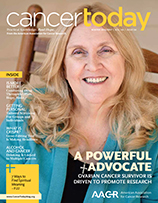 has shared her ovarian cancer story too many times to count. She’s spoken in rooms filled with medical students, educating them about ovarian cancer’s symptoms. She’s testified before Congress to garner support for ovarian cancer research. She’s personified hope on telephone calls with women newly diagnosed with cancer or those who have had a recurrence. Her story is backed by a vast knowledge of ovarian cancer science and bolstered by its uniqueness: There are not many 19-year ovarian cancer survivors.
 Sue Rochman