Cancer Screening in Older Adults: Risks and Benefits

 UnknownWhich older adults should undergo cancer screening? How often?

Although screening strives to reduce cancer deaths, different answers to these questions have led to inconsistent screening guidelines from the U.S. Preventive Services Task Force and leading medical organizations.

To learn more, read my article “Cancer Screening in Older Adults: Risks and Benefits” in the December 2014 issue of the Journal of the National Cancer Institute.

Unknown-1

Cancer Today–Fall 2014

The Forward Look section of the Fall issue of Cancer Today–which I assign and edit–contains a number of articles that speak to important trends in cancer care.

Fall-Cancer-Today-Cover90x115-WEBFirst up: Can a healthy diet reduce cancer risk? That’s the question I posed to Walter Willett, an epidemiologist at the Harvard School of Public Health, who is the “go-to” for many reporters who are writing about diet and disease risk in the Fall Q&A: Eating Well.

If news stories about increasing rates of thyroid cancer have you worried, this article explains why “experts are divided about whether this statistic reflects a true rise in thyroid cancer incidence or is merely a consequence of increased detection resulting from better diagnostic tools.”

Studies show more women are choosing to have a double mastectomy following a cancer diagnosis. This choice appears to be motivated more by fear and and anxiety, as there is no evidence removing the opposite breasts increases breast cancer survival. Read why in Double Mastectomies on the Rise.

Lastly, if you’ve heard of sepsis but aren’t sure what it is or why it’s a problem, you’ll want to read “A Deadly Inflammation.”

The High Cost of Cancer Drugs

Cancer drug prices are sky high. Last night 60 Minutes aired this piece on the “why” behind cancer drug pricing.

It’s not a pretty picture, as this segment of the transcript illustrates:

That’s because media exposure, he says, works! Right after their editorial was published, the drug’s manufacturer, Sanofi, cut the price of Zaltrap by more than half.

Dr. Peter Bach: It was a shocking event. Because it was irrefutable evidence that the price was a fiction. All of those arguments that we’ve heard for decades, “We have to charge the price we charge. We have to recoup our money. We’re good for society. Trust us. We’ll set the right price.” One op-ed in the New York Times from one hospital and they said, “Oh, okay, we’ll charge a different price.” It was like we were in a Turkish bazaar and…

Lesley Stahl: What do you mean?

Dr. Peter Bach: They said, “This carpet is $500” and you say, “I’ll give you $100.” And the guy says, “Okay.” They set it up to make it highly profitable for doctors to go for Zaltrap instead of Avastin. It was crazy!

But he says it got even crazier when Sanofi explained the way they were changing the price.

Dr. Peter Bach: They lowered it in a way that doctors could get the drug for less. But patients were still paying as if it was high-priced.

Lesley Stahl: Oh, come on.

Dr. Peter Bach: They said to the doctor, “Buy Zaltrap from us for $11,000 and we’ll send you a check for $6,000.” Then you give it to your patient and you get to bill the patient’s insurance company as if it cost $11,000. So it made it extremely profitable for the doctors. They could basically double their money if they use Zaltrap.

Read or watch it here: http://alturl.com/mfjrb

The Vaporizing of Big Tobacco

As a journalist, I get a lot of press releases. Most of them come from people who have done a bit of research and know that I cover health. But there are others that are kind of random, like the one I received not that long ago from Sarah, the community manager for Ophis, “the premier luxurious electronic cigarette,” which, she wanted me to know, was “the new must have fashion accessory for 2014.”

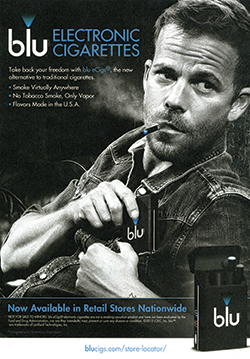
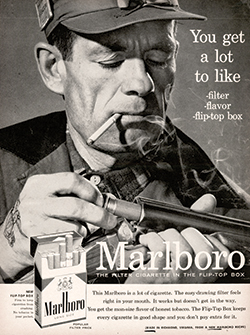
I am not sure how Sarah got my name. Maybe it was because I had recently written a P-15-Blu-E-Cig-Ad-250x359-WEBshort piece for Cancer Today P-15-Marlborough-250x335-WEBhighlighting the advertising tactics used by e-cigarette companies and the ways in which they echo cigarette ad campaigns from years past.

(You can see more at Stanford Research Into the Impact of Tobacco Advertising.)

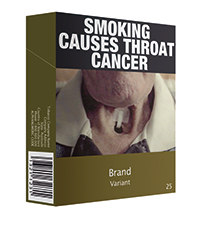
Maybe she saw my article on the graphic health warnings the FDA was hoping to force tobacco P11-3D-Cigarettes-200x225-WEBmanufacturers to put on cigarette packages in the U.S. Or the one I wrote on the graphic plain packaging now required in Australia.

Then again, it could have been my article about Yul Brynner and his haunting anti-smoking PSA, which ran on television stations worldwide within days of his death from lung cancer in 1985.

She might also have known that I had recently assigned and edited  articles for Cancer Today on the controversy over e-cigarettes.

Sarah’s press release included some “cool facts” about Ophis and “its stylish look and appeal.” She also said this:


An article from you = a discount on Ophis.us

We will also promote your post and give your blog the opportunity of reaching a new audience of 1.3K fans on our Facebook page, 9.3K on Twitter, and 300 daily visitors on Ophis.us

I look forward to hearing back from you. Please contact me for more information on Media Inquiry at Sarah@Ophis.us.

Of course, no journalist of any merit would publish something on a blog hoping to get a discount on a product. But feel free to let Sarah know that you saw my post.

News from Cancer Today

As a contributing editor for Cancer Today, the magazine published by the American Association for Cancer Research, I’ve been quite busy keeping on top of the latest cancer research; developing, assigning, and editing news and feature stories; and enjoying getting to know the people behind our bylines.

Some highlights include:

Telling the Tale, my Q&A with medical oncologist Siddhartha Mukherjee, the Pulitzer Prize-winning author of The Emperor of All Maladies

The Proof of the Proton Is in the Result, a piece I assigned and edited that notes that, despite the buzz over this new technology, “ForardLook_ProtonTherapy_350x227webno one knows if proton beam radiation is really better than standard X-ray treatment—an important consideration particularly for the prostate cancer patients to whom it is already heavily marketed.”

Paying a Steep Price, an article  I assigned and edited on new laws that are pushing health insurers to make oral cancer drugs affordable. As this story explains, “Over the past five years, cancer organizations and advocacy groups has pushed 26 states and the District of Columbia to pass oral parity laws,” which require that oral cancer medications be treated as chemotherapy given in a doctor’s office and billed as a routine visit.

Lung Cancer Screening for Smokers, an article I wrote on the new recommendation by the United States Preventive Services Task Force P10-Lungs-350x257-WEBto screen individuals at high risk for lung cancer with low-dose CT scans. The recommendation followed National Lung Screening Trial results which showed that current and former smokers who received regular CT scans were 20 percent less likely to die of lung cancer than those receiving routine chest X-rays.

Changing Perceptions of Palliative Care, a Q&A with Judith Redwing Keyssar on the importance of pallliative care, which I assigned and edited. As the article explains, “Studies have found that 70 percent of the U.S. public is unfamiliar with palliative care … which can be offered from the moment a patient begins treatment.”

African-American Women May Benefit Less From HPV Vaccine, an article I assigned and edited after research results showed that less than 40 percent of African-American women carried HPV-16 and HPV-18, compared with 65 percent of white women. HPV-16 and HPV-18, the two HPV subtypes the HPV vaccines target, are responsible for 70 percent of all cervical cancers.

New Insights Into Pediatric Cancer, my article on a recent discovery that may help explain tumor growth in children. It typically takes decades for normal cells to accumulate all the genetic errors necessary to become cancer cells—this helps explain why a person’s cancer risk increases with age. But when it comes to pediatric cancers this explanation falls short, as it cannot account for the speed with which cancer develops in children. The new finding suggests one reason may be how cellular pathways spur cancer growth in these tumors.

Cancer Today—Winter Issue 2012-2013

The Winter issue of Cancer Today is now available.

I encourage you to take a look at the stories covered in Forward Look, which I developed and edited. It includes stories on genetic ancestry, the link between childhood obesity and adult cancer risk, lung cancer’s stigma and the role of patient navigators, and more.

This issue also includes my article “Missing the Mark,” which continues my exploration into cancer clinical trials. Many people are not aware that only one-third of new cancer therapies or drug combinations tested in phase III clinical trials prove to be better than the standard of care. This article explores why—and how researchers are aiming to improve the odds.

Missing the Mark

If you are a person who likes to gamble, the Super Bowl may be the event for you. Some Vegas oddsmakers have correctly predicted 16 of the last 21 winners—a 75 percent success rate. 

Even so, odds are just that: odds. Time after time the team that just can’t lose does. In the wake of such upsets, sports announcers typically turn to clichés like “misplaced expectations” and “false hopes.”

 Similar platitudes are often heard when a large phase III clinical trial falls short—when a therapy or drug combination that companies have often spent hundreds of millions of dollars and more than a decade developing doesn’t do better than the current standard of care, or does even worse. The difference, however, is that cancer is not a game. Read more

[Note: Special thanks to Larry and Scott for their deadline oddsmaker insights.]

The Winter issue also includes my interview with Margareta Timofti, the new first lady of Moldova. Timofti is committed to lowering her country’s cancer death rates, and she and I spoke (through a translator) while she was in San Francisco on an educational mission sponsored by the Institute of International Education.

Q&A  Gaining the Benefits of Early DetectionWhen Nicolae Timofti was elected president of Moldova by the country’s parliament in March 2012, his wife, Margareta Timofti, rose to international prominence as well. As the country’s new first lady, Timofti intends to use her position to draw attention to women’s health issues—in particular, the thousands of deaths that could be prevented through cancer screening programs.​ Her work will not be easy. Moldova, which is about the size of Maryland and is home to nearly 4 million people, is one of the poorest countries in Eastern Europe. The parliamentary vote that brought her husband to office followed nearly three years of deadlock between Moldova’s ruling, pro-Western Alliance for European Integration and the opposition Communist Party. Even so, since 2009, with the assistance of the International Atomic Energy Agency’s Programme of Action for Cancer Therapy, the country has been taking steps toward implementing its first national comprehensive cancer program. Timofti’s work can build on this foundation. Read more

This issue is also special to me because In the Moment includes this lovely photograph of my friend Julia, who was diagnosed with stage IV breast cancer in 2010. Julia and I first met in the early 1980, when we worked at the UCSD Food Coop selling fruit, vegetables and other new-fangled organic goodies. We’re both still organically inclined, but now we talk about kids, college, new restaurants—and cancer.