The Vaporizing of Big Tobacco

As a journalist, I get a lot of press releases. Most of them come from people who have done a bit of research and know that I cover health. But there are others that are kind of random, like the one I received not that long ago from Sarah, the community manager for Ophis, “the premier luxurious electronic cigarette,” which, she wanted me to know, was “the new must have fashion accessory for 2014.”

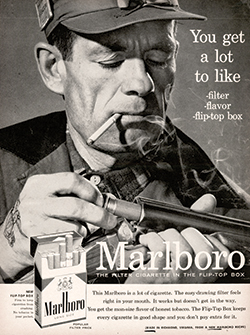
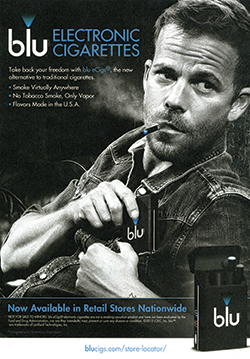
I am not sure how Sarah got my name. Maybe it was because I had recently written a P-15-Blu-E-Cig-Ad-250x359-WEBshort piece for Cancer Today P-15-Marlborough-250x335-WEBhighlighting the advertising tactics used by e-cigarette companies and the ways in which they echo cigarette ad campaigns from years past.
(You can see more at Stanford Research Into the Impact of Tobacco Advertising.)

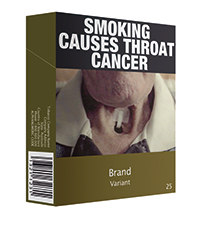
Maybe she saw my article on the graphic health warnings the FDA was hoping to force tobacco P11-3D-Cigarettes-200x225-WEBmanufacturers to put on cigarette packages in the U.S. Or the one I wrote on the graphic plain packaging now required in Australia.
Then again, it could have been my article about Yul Brynner and his haunting anti-smoking PSA, which ran on television stations worldwide within days of his death from lung cancer in 1985.

She might also have known that I had recently assigned and edited  articles for Cancer Today on the controversy over e-cigarettes.

Sarah’s press release included some “cool facts” about Ophis and “its stylish look and appeal.” She also said this:


An article from you = a discount on Ophis.us

We will also promote your post and give your blog the opportunity of reaching a new audience of 1.3K fans on our Facebook page, 9.3K on Twitter, and 300 daily visitors on Ophis.us

I look forward to hearing back from you. Please contact me for more information on Media Inquiry at Sarah@Ophis.us.

Of course, no journalist of any merit would publish something on a blog hoping to get a discount on a product. But feel free to let Sarah know that you saw my post.

News from Cancer Today

As a contributing editor for Cancer Today, the magazine published by the American Association for Cancer Research, I’ve been quite busy keeping on top of the latest cancer research; developing, assigning, and editing news and feature stories; and enjoying getting to know the people behind our bylines.

Some highlights include:

Telling the Tale, my Q&A with medical oncologist Siddhartha Mukherjee, the Pulitzer Prize-winning author of The Emperor of All Maladies

The Proof of the Proton Is in the Result, a piece I assigned and edited that notes that, despite the buzz over this new technology, “ForardLook_ProtonTherapy_350x227webno one knows if proton beam radiation is really better than standard X-ray treatment—an important consideration particularly for the prostate cancer patients to whom it is already heavily marketed.”

Paying a Steep Price, an article  I assigned and edited on new laws that are pushing health insurers to make oral cancer drugs affordable. As this story explains, “Over the past five years, cancer organizations and advocacy groups has pushed 26 states and the District of Columbia to pass oral parity laws,” which require that oral cancer medications be treated as chemotherapy given in a doctor’s office and billed as a routine visit.

Lung Cancer Screening for Smokers, an article I wrote on the new recommendation by the United States Preventive Services Task Force P10-Lungs-350x257-WEBto screen individuals at high risk for lung cancer with low-dose CT scans. The recommendation followed National Lung Screening Trial results which showed that current and former smokers who received regular CT scans were 20 percent less likely to die of lung cancer than those receiving routine chest X-rays.

Changing Perceptions of Palliative Care, a Q&A with Judith Redwing Keyssar on the importance of pallliative care, which I assigned and edited. As the article explains, “Studies have found that 70 percent of the U.S. public is unfamiliar with palliative care … which can be offered from the moment a patient begins treatment.”

African-American Women May Benefit Less From HPV Vaccine, an article I assigned and edited after research results showed that less than 40 percent of African-American women carried HPV-16 and HPV-18, compared with 65 percent of white women. HPV-16 and HPV-18, the two HPV subtypes the HPV vaccines target, are responsible for 70 percent of all cervical cancers.

New Insights Into Pediatric Cancer, my article on a recent discovery that may help explain tumor growth in children. It typically takes decades for normal cells to accumulate all the genetic errors necessary to become cancer cells—this helps explain why a person’s cancer risk increases with age. But when it comes to pediatric cancers this explanation falls short, as it cannot account for the speed with which cancer develops in children. The new finding suggests one reason may be how cellular pathways spur cancer growth in these tumors.